PMP exam strategy · The Thin Line Method
PMP situational questions: how to choose between two correct answers
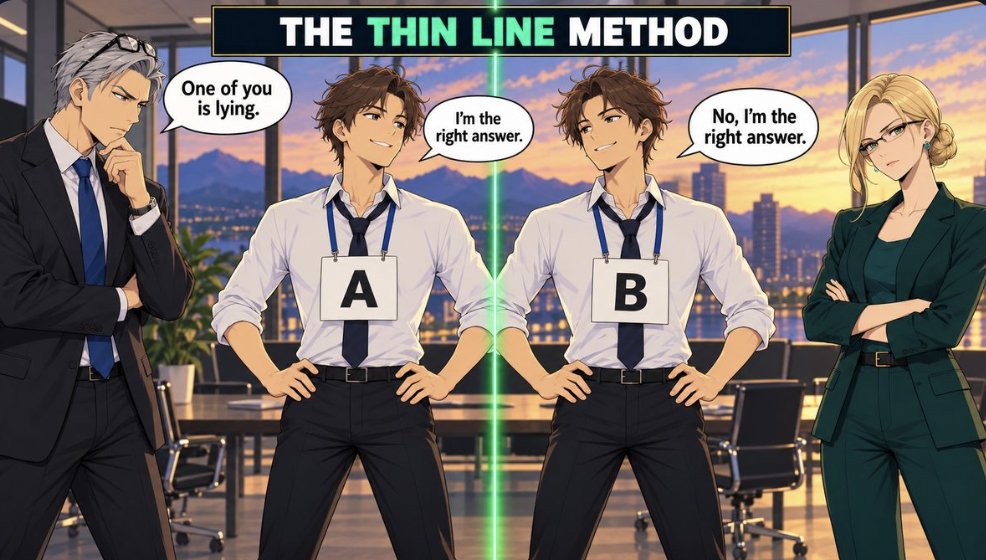
The Thin Line Method: 4 answers, 2 twins with one different detail.
You know the PMBOK, you've studied Agile and you understand risk registers, stakeholder engagement and enough project management terminology to ruin an enjoyable dinner conversation. Then you open a PMP practice question and eliminate 2 answers. Excellent. The remaining 2 sound equally convincing, like consultants charging $500 an hour. You hesitate, change your answer, change it back. Submit. Naturally, your first instinct was correct.
Welcome to one of the most frustrating parts of PMP preparation: knowing the theory but struggling to pick the best decision when two answers look correct. That's why I developed the Thin Line Method. Let's investigate.
1. Why Two PMP Answers Can Both Look Correct
Here's what I noticed while preparing for the PMP exam and building ExamInstinct.
Imagine a stakeholder is concerned about project progress. What should the project manager do?
- A. Meet the stakeholder to understand their concerns.
- B. Review the stakeholder engagement plan.
- C. Assess whether the concerns affect project objectives.
- D. Escalate the concerns to the sponsor.
All 4 could be reasonable in different circumstances. Without knowing what has already happened and what needs to happen next, you can't confidently choose. Sometimes the missing clue is an entire sentence. Sometimes it's one word: ALREADY. APPROVED. FIRST. BEFORE. AFTER. Miss it, and you can spend 3 minutes debating 2 answers that were never equally appropriate.
The PMP trap
An answer can sound perfectly right and still be wrong.
The trick? Choose what works for the situation, not what sounds good in a textbook.
2. The Thin Line Method: Four Steps to Make the Call
I started treating PMP questions like crime scenes. Every scenario contains evidence. Every answer is a suspect. Somewhere in the paragraph is the detail that changes the decision. Find the evidence before the suspects start looking innocent.
Step 1: Find the thin line
Strip away the corporate decoration. A PMP question introduces three suppliers, six stakeholders, an unhappy sponsor, and a project manager who hasn't taken a holiday since 2019. Interesting, but what actually needs to be decided? Ask yourself: What happened? What has already been done? What needs to happen now? Then reduce the situation to one sentence. If you can't write that sentence, you haven't understood the question yet, and the options won't rescue you.
For example: a supplier is late, the recovery plan has been approved, and the sponsor wants an updated forecast.
The thin line is "The plan is approved, and the sponsor needs a reliable forecast." Don't solve the supplier delay again. Deal with what's still unresolved.
Step 2: Find the decisive fact
Small details, expensive consequences. Look for words that reveal timing, authority or the current status.
| Clue | What to check |
|---|---|
| ALREADY | Has this action been completed? |
| FIRST / NEXT | What needs to happen now? |
| APPROVED | Has authorization been granted? |
| NOT YET | What's still missing? |
| WITHIN AUTHORITY | Who can make the decision? |
| CRITICAL PATH | Is the schedule at risk? |
Imagine the scenario says, "The change request has already been approved," and an answer suggests submitting it for approval. That answer is solving a problem that no longer exists.
PM Instinct
Don't repeat an action the scenario says has already happened.
Free: the PMP Trap-Phrase Decoder
The phrasings the exam uses to bait wrong answers, and the move to pick instead. Instant download, emailed too. Finish Case 1 to unlock the full 70-page guide.
No spam. Unsubscribe anytime.
Step 3: Put the answers on trial
In ExamInstinct, every choice is scored one of three ways:
Textbook the answer PMI expects in this situation. This is the one the exam rewards.
Defensible a reasonable move a competent PM could justify, but not the best one here.
Risky fast and confident, but it skips a step.
On the exam, only the textbook answer scores. The defensible ones are the answers that make you hesitate.
Step 4: Make the call
Choose the action that fits the facts, the timing and the responsibilities. And please don't choose "collaborate" every time you see it. Collaboration is valuable. So is knowing what you're collaborating about.
Now let's investigate a real decision.
3. Crime Scene #001: The Vendor Delay
4 suspects. 2 convincing stories. 1 missing piece of evidence.
Original fictional PMP-style practice scenario.
You're managing a hybrid project for a financial services company.
A critical vendor component is delayed by two weeks, threatening an integration activity on the critical path and potentially a regulatory milestone.
The technical lead has prepared a recovery proposal involving resequenced activities and additional testing resources. It could protect the milestone, but it increases costs beyond the project manager's delegated authority.
The sponsor wants an updated delivery commitment before tomorrow's executive meeting.
What should the project manager do NEXT?
- A. Review the recovery proposal with the team, validate its feasibility and schedule impact, and present the recommended response to the appropriate decision-makers.
- B. Submit the recovery proposal to the change control authority for approval before committing to the revised delivery plan.
- C. Escalate the vendor delay to the executive steering committee because the regulatory milestone is at risk.
- D. Inform the sponsor that the milestone cannot be guaranteed until the vendor confirms a new delivery date.
Which answer would you choose? A and B both look good, and both involve appropriate project management practices. One detail separates them.
Find the evidence
The technical lead has prepared a recovery proposal. Prepared. Not validated, not assessed, not approved.
The PM knows the extra cost exceeds their authority, but nobody has established yet whether the proposal will work.
The thin line: The recovery plan is ready, but nobody has checked if it will actually work.
Now examine the suspects.
Suspect A: Validate the proposal
Textbook · Best answerBefore asking for approval, the PM needs to check whether the recovery plan will actually work. Will the extra resources help? Can the team still meet the deadline? What will it cost?
Once these questions are answered, the plan can be submitted for approval. A doesn't skip the approval process. It makes sure we're not asking people to approve a plan that might not work.
Suspect B: Request approval
Defensible · Wrong momentThe plan costs more than the PM is allowed to approve, so someone higher up needs to say yes. But there's a problem: nobody has checked if the plan will actually work.
Asking for approval now is too early. Otherwise, we'll have one meeting to approve the plan and another to figure out whether it makes sense. The approval is necessary but the timing is wrong.
Suspect C: Escalate the delay
Risky · Skips a stepThe deadline is at risk, so involving senior management might be necessary. But first, the PM needs to check whether the recovery plan will work.
Otherwise, you're telling executives there's a problem without offering a possible solution. Congratulations! You've turned your problem into everyone's problem.
Suspect D: Refuse to guarantee the date
Defensible · IncompleteThe sponsor wants to know if the deadline can still be met. But instead of checking the recovery plan, the PM waits for the vendor to provide a new date.
Great. Now the entire project schedule depends on an email from the vendor.
The call: A
Validate the recovery proposal and prepare an evidence-based recommendation.
PM Instinct: A proposal isn't an assessed solution. And an assessed solution isn't an approved decision. Remember that distinction, because we're about to change the evidence.
4. Change one detail in a PMP question, and the correct answer might change completely.
Same supplier, same project, same sponsor who wants an answer yesterday. But now the scenario says:
"The project team has completed the impact assessment, validated the recovery proposal, and confirmed that the additional cost exceeds the project manager's delegated authority."
Everything else stays the same: the supplier is still late, the milestone is still threatened, and the sponsor still wants a commitment. One fact changed. The proposal has already been validated.
Reconsider the two strongest answers:
- A. Review the proposal and validate its feasibility and impact.
- B. Submit the proposal to the change control authority for approval.
Which is better now? B. The assessment is complete. Authorization is what's missing, and repeating the analysis would delay the decision without addressing it.
| Scenario | What's missing | Best next action |
|---|---|---|
| Proposal prepared | Validation | A: validate first |
| Proposal validated | Authorization | B: request approval |
Same project, same two plausible answers, different best next action.
The real PMP reflex
Don't stop at "Why is A correct?" Ask: "What would need to change for B to become correct?"
That's how you find out whether you understand the reasoning or just remember the answer. Memorizing yesterday's correct answer is a fantastic way to make tomorrow's wrong decision. With confidence.
5. Why I Built ExamInstinct Around Decisions
This was one of my biggest frustrations with traditional PMP preparation. I'd answer a question, read the explanation and move on. Then a similar situation appeared with slightly different facts, and suddenly I wasn't so confident anymore. I didn't need another explanation telling me the correct answer was B. I needed to understand what made B correct, and what would make it wrong.
That's one of the ideas behind ExamInstinct, an interactive decision-training simulation with six industry cases, recurring characters and evolving project situations. The problems don't disappear after one question. Characters return, priorities change, and earlier decisions have consequences, because that's what happens on actual projects.
The sponsor remembers your promise. The customer remembers your deadline. The technical lead says everything is ready. The testing dashboard looks like a Christmas tree, and Finance is investigating who authorized the second box of printer paper.
ExamInstinct puts you in the middle of real-world project chaos, where decisions have consequences, yesterday's solution becomes today's problem, and memorizing the textbook won't save you.
Your Turn
You've learned the Thin Line Method, investigated the suspects, and seen how one small detail can change the best decision. Now imagine this.
The customer requests a critical new feature. The Product Owner agrees it could deliver significant business value. The sprint is already full, but the technical lead confirms the team could deliver the feature by replacing a lower-priority item.
The sponsor loves the idea. Naturally. He has already mentioned it in tomorrow's executive presentation, and he wants an answer today.
WHAT WOULD YOU DO FIRST?
Would you ask the Product Owner to reprioritize the backlog? Discuss the trade-off with the team? Or involve the sponsor before making any changes? All 3 sound reasonable. One missing piece of information could change the decision.
THINK YOU CAN MAKE THE CALL?
Try Case 1 freeStop Memorizing.
Start Thinking Like a PM.
Want to know what the new PMP exam actually looks like?
New PMP exam 2026: what changed, how I passed & what nobody warned me about
I took the updated PMP exam in July 2026. Here's what surprised me about the format, case studies, breaks and preparation.
A Note from ExamInstinct
The Thin Line Method is an ExamInstinct educational approach for analyzing situational project management questions. It is not an official PMI examination technique.
The scenarios in this article are original fictional examples, not actual PMP examination questions. Their suggested answers depend on the stated assumptions.
ExamInstinct is an independent project management decision-training simulation and is not affiliated with, sponsored by, or endorsed by the Project Management Institute.
PMP®, PMI®, and PMBOK® are registered marks of the Project Management Institute, Inc.